
What Is On Page SEO and Off Page SEO? Beginner Friendly Guide
If you are new to the world of digital marketing, you have likely heard the terms thrown around quite a bit. But understanding exactly what is on-page SEO and off-page SEO is the first step toward building a successful website. So, what is on page seo and off page seo?
In simple terms, SEO is split into two main pillars: the stuff you do on your own website, and the stuff you do elsewhere on the internet to boost your site’s reputation. To rank on the first page of Google, you cannot have one without the other. You need to master both on page seo and off page seo to create a strategy that drives traffic and builds authority.
In this blog, we will break down the differences, the tactics involved, and why you need both for long-term success.
What is On-Page SEO?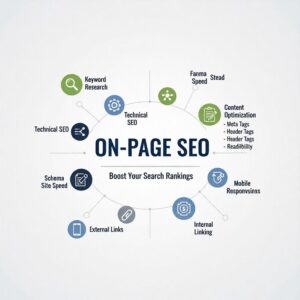
To answer the question of what is on page seo and off page seo, we must start with the foundation: on-page SEO. This refers to all the measures you can take directly within your website to improve its position in search rankings. When people search for what is on page seo and off page seo, they are often looking for this clear distinction.
Think of on-page optimization as the “content” and “structure” of your house. If Google is coming to visit, you want the rooms to be tidy, the layout to be clear, and the signs to be easy to read. On-page SEO tells Google what your page is about.
Key Elements of On-Page SEO
When optimizing on-page, you are focusing on factors that you have 100% control over. Here are the most critical components:
-
High-Quality Content: This is the king. If your content is thin, copied, or unhelpful, nothing else matters. Google’s primary goal is to answer the user’s query.
-
Title Tags (Meta Titles): This is the clickable headline that appears on search engine results pages (SERPs). Your primary keyword (like “on page seo and off page seo”) should appear here.
-
Meta Descriptions: This is the short blurb under the title. While not a direct ranking factor, a compelling meta description increases your Click-Through Rate (CTR), which does help rankings.
-
Header Tags (H1, H2, H3): These structure your content for both users and search engines. They make the text scannable and help Google understand the hierarchy of information.
-
Keyword Optimization: You need to naturally place your target keywords throughout the text, especially in the first 100 words. However, avoid “keyword stuffing”—write for humans first.
-
Internal Linking: Linking to other relevant pages on your own website helps spread “link juice” and keeps users engaged longer.
-
Image Optimization: Compressing images and using descriptive alt text helps search engines understand what the images are about and improves accessibility.
-
URL Structure: Short, descriptive URLs with keywords are better than long strings of numbers.
By perfecting on page seo, you make your website digestible for search engine bots. It ensures that when Google crawls your site, it knows exactly what topics you cover.
What is Off-Page SEO?
Now, let’s look at the other half of the equation when discussing what is on page seo and off page seo. If on-page SEO is the content and structure of your house, off page seo is the reputation of your neighborhood. It is everything you do outside your website to improve its authority and trustworthiness.
Why does this matter? Google assumes that if many other reputable websites link to you, you must be a valuable resource. It acts as a vote of confidence. Without off-page optimization, even the most beautifully written article can struggle to rank because it lacks authority.
Key Elements of Off-Page SEO
While On Page relies on direct input, Off Page relies on building relationships and trust. The primary factors include:
-
Backlinks (Inbound Links): This is the most important off-page factor. A backlink is when another website links to your page. The quality of the linking site matters more than the quantity. One link from a major news outlet (like Forbes or BBC) is worth more than hundreds of links from spammy blog comments.
-
Domain Authority: This is a search engine ranking score that predicts how well a website will rank. It is built largely through high-quality backlinks.
-
Social Media Marketing: While social shares are not a direct ranking factor, they increase your content’s visibility. More visibility leads to more people seeing your content, which can lead to more natural backlinks.
-
Guest Blogging: Writing articles for other reputable websites in your industry allows you to include a link back to your own site. This builds authority and exposes you to a new audience.
-
Brand Mentions: Even unlinked mentions of your brand name can signal to Google that you are a trusted entity in your space.
Mastering the answer to what is on page seo and off page seo means understanding that Off Page SEO is a long game. It requires patience and consistent effort to build a profile of links that signals to Google that your site is a pillar of the community.
Why You Need Both On-Page and Off-Page 
You might be wondering, “Can I just focus on one?” The answer is no. There is a symbiotic relationship between on page seo and off page seo.
Imagine you build a brilliant, informative article about “on page seo and off page seo” (On Page), but no one links to it. Google might think, “Well, the content is good, but nobody is talking about it,” and keep it on page 5.
Conversely, imagine you get a ton of links to your site (off-page), but when users click through, they find a poorly written, disorganized page with a bad user experience. They will hit the “back” button immediately, increasing your bounce rate and telling Google your site isn’t actually that helpful.
You need the combination:
-
On-page SEO convinces Google you are relevant to the search term.
-
Off-page SEO convinces Google you are authoritative on the subject.
